What Is a Hydrogen Water Bottle?
A portable device that dissolves molecular hydrogen gas (H₂) into drinking water through electrolysis — producing hydrogen-rich water measured in parts per billion (ppb).
This differs fundamentally from alkaline water. Alkaline water has a higher pH (8–9.5) but does not necessarily contain dissolved H₂. Hydrogen water is defined by its dissolved H₂ concentration — not by its pH.

How H2CAP Plus Works
A proton-exchange membrane (PEM) splits water and keeps pure hydrogen on the side you drink.
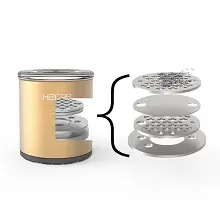
Water Splitting
Platinum-coated titanium electrodes split water (H₂O) into hydrogen and oxygen — efficiently and without metal leaching.
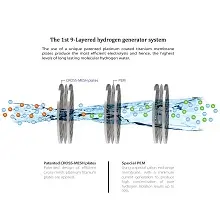
Selective Membrane
The PEM infuses hydrogen into your water while venting oxygen and trace byproducts separately. No unwanted gases reach your glass.
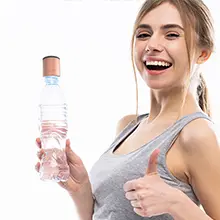
1,500 ppb in 3:30
H2CAP Plus consistently reaches 1,200–1,500 ppb — the range used in most positive peer-reviewed research protocols.
Basic Electrolysis vs. SPE / PEM
The critical difference between a cheap device and H2CAP Plus lies in the membrane.
| Feature | Basic Electrolysis | SPE / PEM — H2CAP Plus |
|---|---|---|
| H₂ / O₂ separation | Mixed in water | Fully separated |
| Ozone / chlorine byproducts | Possible | None |
| Concentration achievable | 300–600 ppb | Up to 1,500 ppb |
| Electrode material | Stainless / titanium | Platinum-coated titanium |
| Water pH change | Unpredictable | Minimal (H₂-selective) |