Hydrogen Water Bottle: The Complete Guide to H2CAP PLUS
A 53-gram cap that turns an ordinary bottle of water into hydrogen water in 3 minutes 30 seconds. Here is how it works, what we measured, and how we measured it.
What is a hydrogen water bottle?
A hydrogen water bottle is a portable device that dissolves molecular hydrogen (H₂) gas into drinking water through electrolysis. Most units use an SPE/PEM membrane to separate hydrogen from oxygen, producing hydrogen-enriched water without ozone or chlorine. Concentration is measured in parts per billion (ppb) or parts per million (ppm) of dissolved hydrogen.
How the H2CAP PLUS generates hydrogen
The H2CAP PLUS is not a filter and it does not treat the water. It runs an electric current through it.
Electrolysis, separated by a membrane
Water contains H₂O molecules. Apply a current across two electrodes and those molecules split: hydrogen gas collects at the negative electrode, oxygen at the positive one. Do this in an open cup and you get both gases mixed into the water — along with chlorine and ozone if the water contains dissolved salts.
The H2CAP PLUS avoids this using a proton exchange membrane (PEM). The membrane sits between the two electrodes and allows only hydrogen ions to pass through. Oxygen, ozone and chlorine generated on the other side are vented out of the unit rather than dissolved into the water. In our measurements this separation reaches approximately 99%.
Nine layers, cross-mesh geometry
The generator uses a nine-layer stack of platinum-coated titanium plates. Platinum is used because it resists corrosion at the electrode surface — a plate that degrades produces less hydrogen and eventually leaches metal into the water. The plates use a cross-mesh pattern rather than a flat disc, which increases the surface area in contact with the water within the same 37 mm footprint.
Design covered by Korean patents 10-1867370 & 10-2283295, IonFarms Co., Ltd.Why no battery
Most portable hydrogen generators run on a lithium battery, which loses capacity over time — a two-year-old unit produces measurably less hydrogen than a new one. The H2CAP PLUS has no battery. It draws up to 4.5 W directly over USB from a power bank, laptop, or wall adapter. There is nothing in the unit that degrades on a charge cycle.
What it runs on
A digital control board adjusts the cycle to the water. A run takes 3 minutes 30 seconds to 5 minutes depending on water condition. Recommended volume is 500 ml, at a water temperature below 50 °C. It fits 28 mm and 30 mm screw caps.
How much hydrogen, and how long it stays there
Every hydrogen water bottle publishes a peak number. Almost none publish what happens to it an hour later. Hydrogen is the smallest molecule in existence — the interesting question was never how much goes in, it’s how much is still there when you drink it.
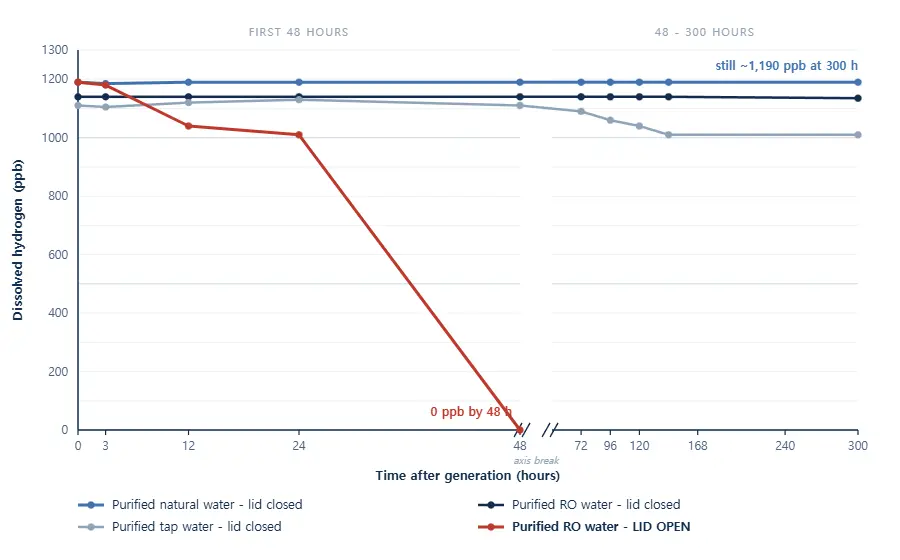
Measured with a Trustlex ENH-2000 (±5 ppb). Four conditions tracked over 300 hours; axis is broken between 48 h and 300 h to show early behavior clearly.
| Condition | At 0 h | At 24 h | At 300 h |
|---|---|---|---|
| Purified natural water, lid closed | ~1,190 ppb | ~1,190 ppb | ~1,190 ppb |
| Purified RO water, lid closed | ~1,140 ppb | ~1,140 ppb | ~1,135 ppb |
| Purified tap water, lid closed | ~1,110 ppb | ~1,130 ppb | ~1,010 ppb |
| Purified RO water, lid open | ~1,190 ppb | ~1,010 ppb | 0 ppb by 48 h |
The lid is not a detail
Open, the water is effectively flat within two days. Closed, it holds. If you take one thing from this page: keep the cap on until you drink it.
Water type matters less than people assume
Natural, RO, and tap all land within about 200 ppb of each other. Use what you have.
The honest state of the evidence
We sell a device that dissolves hydrogen into water. We don’t sell a health outcome, and this section is where we explain why.
Where it started
In 2007, a team at Nippon Medical School published a paper in Nature Medicine proposing that molecular hydrogen acts as a selective antioxidant — reacting with the hydroxyl radical, one of the most damaging reactive oxygen species, while leaving other ROS alone, since those have normal physiological roles. That selectivity is what made the idea interesting. Most antioxidants aren’t selective. The paper set off a large research effort; hydrogen has since been studied in over 170 human and animal disease models.
Where it stands now
Most of that work is in cell cultures and animals. Human trials exist, but they’re small, short, and use varied endpoints — which makes them hard to pool into a conclusion. Some report effects. Some don’t. Large, long, well-powered human trials are the thing the field does not yet have.
And the mechanism is contested
This is the part the industry doesn’t mention. The selective-antioxidant explanation has been directly challenged in published work: the reaction between H₂ and the hydroxyl radical is too slow, at the concentrations achievable in drinking water, to account for much of anything physiologically. Researchers who take this position generally still think hydrogen does something; they argue the mechanism is different and not yet understood.
What has been verified, and by whom
Most hydrogen water bottles are sold on a single number printed on the box. We would rather show you where our numbers come from.
Third-party testing
Tested by the Japan Hydrogen Water Promotion Association (JHPA), October 2018. Result: 1,036 ppb, measured with a Trustlex ENH-1000, mineral water, immediately after a 3:30 cycle. Report No. 218H-221.
Our own laboratory
IonFarms operates a corporate research institute formally recognized under Korea’s national R&D certification program (KOITA). Hydrogen: Trustlex ENH-2000 (±5 ppb). ORP: WTW MultiLab Pro 40 IDS.
Patents
The H2CAP PLUS generator is covered by Korean patents 10-1867370 and 10-2283295. IonFarms holds 12 registered patents in total across its water electrolysis technology.
Three and a half minutes, start to finish
Fits standard 28 mm and 30 mm screw-cap bottles.
Fill the bottle. Attach the H2CAP and turn it upside down — the electrode has to sit in the water.
Connect USB. It starts on its own — laptop, power bank, or wall adapter.
Wait 3:30–5:00, depending on the water. The orange LED comes on when it’s done. Run it twice, or start with mineral or alkaline water, to reach up to 1,500 ppb.
| Light | Meaning |
|---|---|
| White, steady | Producing |
| White, blinking | Cleaning cycle running |
| Orange, steady | Done |
| Orange, blinking | Done — plates need descaling |
Any USB source works. Phones need an OTG adapter; iPhones aren’t supported. Keep the connector dry.
Full instructions, storage, and error codesFour things worth checking before you buy
Hydrogen water bottles are marketed almost entirely on ppb. It is the least useful number on the page, because almost nobody publishes the conditions behind it.
Is the figure attached to conditions?
Dissolved hydrogen depends on water type, temperature, cycle count, and electrode age. A figure without those four things is a headline, not a measurement.
What was it measured with?
Reagent drops and ORP meters are common but unreliable for dissolved hydrogen. Purpose-built H2 meters are the only instruments cited in published research.
Does it separate oxygen and ozone?
Without a membrane, hydrogen, oxygen, ozone and chlorine all end up in your glass. Ask whether there’s a PEM, and what separation it achieves.
Is there a battery?
Lithium cells lose capacity. A generator that ran at rated output when new won’t two years later — and there’s usually no indicator that tells you.
| H2CAP PLUS | |
|---|---|
| Form | Bottle cap — fits standard 30 mm screw-cap bottles |
| Separation | PEM, 99% measured |
| Battery | None — USB powered |
| Measurement | ENH-2000, conditions published |
Three situations this was built for
You already buy bottled water
The H2CAP PLUS is a cap, not a bottle. It screws onto a standard 30 mm bottle neck — the size used by most mineral water sold in Europe, the US, and Asia. At 53 grams it weighs less than the water in a shot glass.
You work somewhere with a USB port
No battery, no charging cycle. Plug in, run for three and a half minutes, unplug. Because nothing degrades on a charge cycle, output at year five should look like output at week one.
You want to check the numbers yourself
A DH and pH test kit is available separately. Every figure we publish includes the water type, temperature, cycle, and instrument used, so you can reproduce it.
Common questions
Does hydrogen water actually do anything?
How long does the hydrogen stay in the water?
What kind of water should I use?
Will it work on my bottle?
Is there any chlorine or ozone in the water?
Why does the orange light come on?
Questions about the H2CAP PLUS?
We publish our test conditions because we would rather you check them than take our word for it. If something in the data does not add up, or you want a figure we have not published, ask.
Ask a question