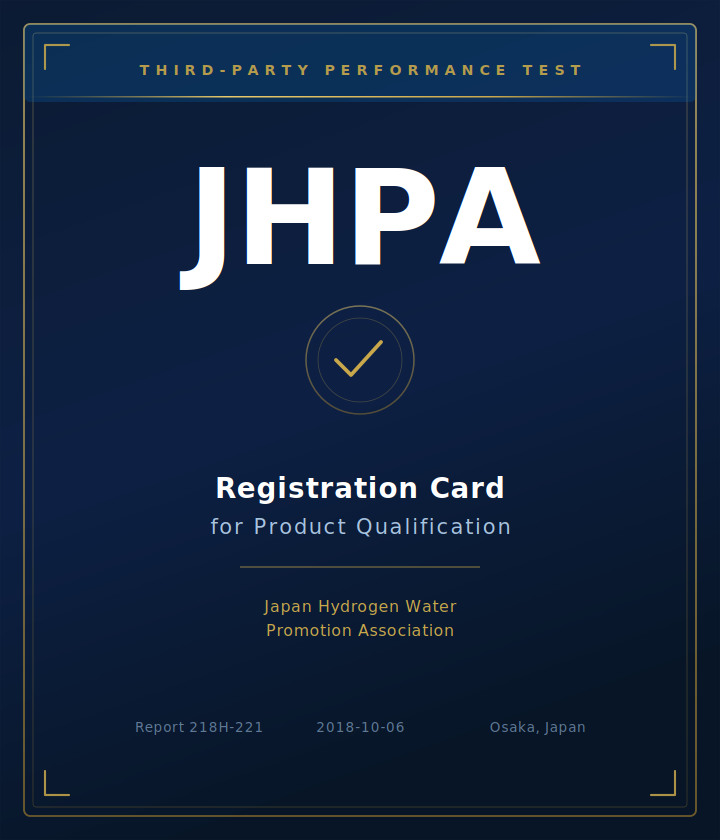
Full hydrogen water bottle test data for the H2CAP PLUS — dissolved H₂ across cycles, water types, and time. One figure is third-party; the rest are ours, with the method stated so you can repeat them.
Most product pages give you one big number and no context. A hydrogen water bottle test only means something with the conditions attached — which water, which instrument, and how many seconds after the cycle stopped. All three are below.
1,036ppb · JHPA verified
1,000–1,500ppb · our range
300 hsealed retention
JHPA (Japan), October 2018 — Report 218H-221
How we measured this
The method, stated plainly
InstrumentsTrustlex ENH-2000 for ppb; WTW MultiLab Pro 40 IDS for ORP.
FillBottle filled to 90%, one standard 3:30 cycle unless noted.
TimingMeasured immediately after generation — before gas escapes.
RepeatsThree cycles per condition, averaged.
Why spell all this out? Because in a hydrogen water bottle test the method changes the answer more than the device does. Measure five minutes late and a genuine 1,300 ppb reads as 400. Use a peak-hold meter and you capture a spike that no drinker ever experiences. Our figures use dissolved-hydrogen readings taken the way you would actually drink the water — sealed, fresh, averaged.
Dissolved H₂ over 300 hours — sealed vs open, across water types.
The lid is not a detail
Sealed, dissolved hydrogen stays above 1,000 ppb for 300 hours across every water type we tested. Leave the lid open, and the same water falls below measurable H₂ within about 48 hours.
This is physics, not a product flaw: H₂ is the smallest molecule and escapes any open surface. It is also why a peak ppb number means little without a timestamp — the honest question is not "how high" but "how high, measured when."
Practically, it means one habit matters: drink within the first hour, or keep the cap sealed until you do. Nothing about the electrode or the water chemistry changes that — an open glass on a desk simply loses gas to the air, the same way carbonated water goes flat.
Output by water type
Purified / RO
1,000–1,200
ppb · extended cycle
Tap water
1,200–1,400
ppb · standard cycle
Mineral water
1,300–1,500
ppb · standard cycle
Don't take our word for it
Reproduce this hydrogen water bottle test at home
A published number you cannot check is just a nicer-looking claim. So here is how to verify every figure on this page yourself, with equipment that costs less than the device. Run the same hydrogen water bottle test we did, on your own water, and hold our numbers to account.
The whole point of publishing a method is that you can run it. The affordable route is a methylene-blue titration kit: each drop neutralizes roughly 100 ppb of dissolved H₂, so counting drops to a color change gives you a ballpark in under a minute — enough to tell a real 1,200 ppb reading from a 500 ppb one. The precise route is an electrochemical DH meter (Trustlex ENH series), the same instrument class behind our figures and the third-party report.
Two rules decide whether your hydrogen water bottle test means anything: measure within seconds of the cycle finishing, and keep the sample sealed until the probe is in. Compare your reading to the water-type table above using the same source water, and you should land inside our published range. If you do, the numbers were real; if a competitor's device cannot, you have learned something too.